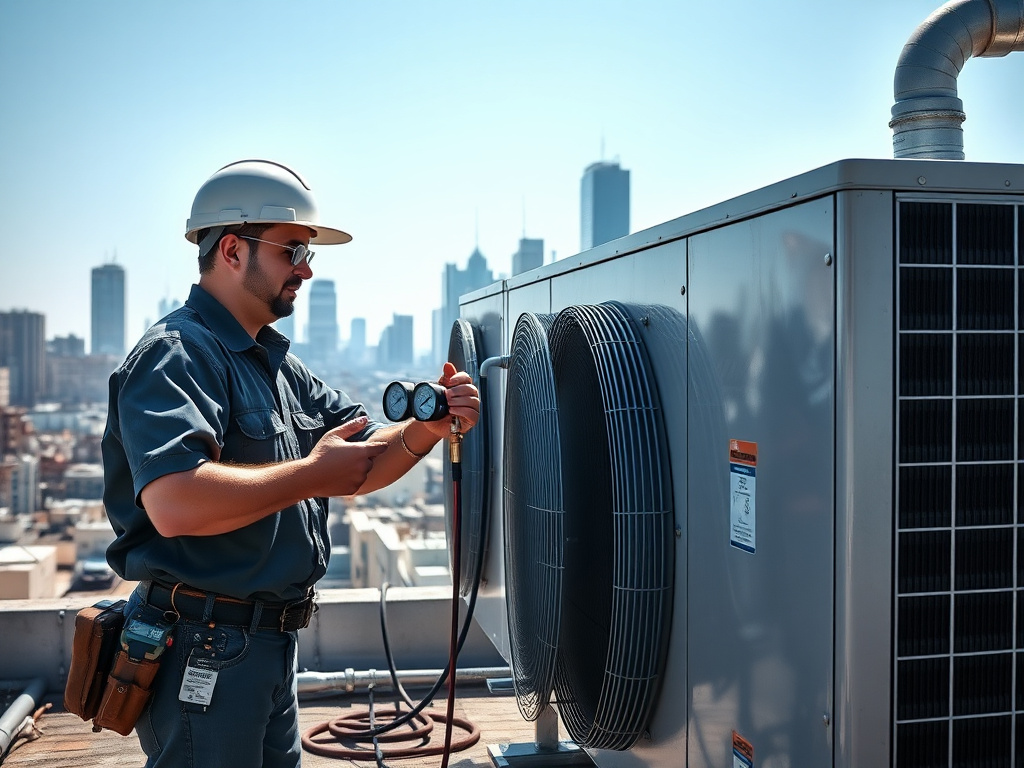
HVAC Contractor Insurance
Insurance Built Around Refrigerant, Combustion & Rooftop Risk
HVAC risk isn't just fall risk on a ladder or a rooftop hatch — it's an environmental exposure from refrigerant handling and a fire/explosion exposure from gas line and combustion equipment work, layered on top of the usual jobsite injury picture. Your coverage should reflect all three, not just one.
Risk profile
Why HVAC risk is three exposures stacked on top of each other
Most construction trades have one or two dominant risk drivers. HVAC has three, and they don't overlap much, which is exactly why a generic contractor quote tends to miss the mark on this trade specifically. The first is refrigerant handling — an environmental, EPA-adjacent exposure that most other construction trades simply don't carry at all. Refrigerant recovery, charging, and disposal are federally regulated, and a release during handling or transport is treated by insurers as a pollution event, not an ordinary property-damage claim.
The second is rooftop and attic/crawlspace access. A large share of commercial HVAC work involves getting to rooftop condenser and package units, which means ladder access, roof hatches, and working near roof edges — fall and heat-stress injury risk that shows up in workers' comp claims in a pattern distinct from trades that stay entirely at ground level.
The third is combustion equipment and gas line work. Furnace installation, gas pack systems, and any work connecting to a gas line introduces a fire and explosion exposure that the cooling side of the trade doesn't have. A contractor who does mostly straight electrical air-conditioning replacement has a meaningfully different risk profile than one whose business is heavily weighted toward furnace and combustion-equipment installation, even though both operate under the same "HVAC contractor" label.
On top of all three of those, HVAC revenue is often seasonal in a way steadier trades aren't — a cooling-heavy business swings hard between summer and winter demand, which affects payroll-based cost calculations differently than a trade with level year-round work. None of this means HVAC is simply "high risk" across the board — it means the risk is spread across categories that a one-size-fits-all contractor policy typically doesn't distinguish between.
The coverage combination
What an HVAC contractor typically carries, and why each piece is there
Seven lines, each addressing a specific piece of the three-part risk picture above — not a generic bundle with the trade name swapped in.
| General liability | The base policy for third-party bodily injury and property damage, including completed-operations exposure from installed systems — a failed connection, an improperly sized unit, or ductwork that causes property damage after the job is finished. |
|---|---|
| Workers' compensation | Covers crew injuries from rooftop unit access (fall risk on ladders and roof hatches), attic and crawlspace work (heat stress, confined space), and the physical strain of moving heavy equipment into place. |
| Tools & equipment (inland marine) | Refrigerant gauges, recovery units, brazing equipment, and other specialty tools represent significant replacement cost — written separately from GL since vehicle-stored tools typically aren't covered under standard commercial auto or property policies. |
| Contractors pollution liability | Specifically for refrigerant release and handling exposure. Refrigerant recovery and disposal is EPA-regulated, and a release, whether from a leak, an improper recovery procedure, or transport, is treated as an environmental/pollution event that standard GL often excludes. |
| Commercial auto | For the service fleet running to residential and commercial calls. Scales with fleet size, and matters more for HVAC than for trades running fewer vehicles, given how service-call-driven the business model typically is. |
| Umbrella/excess liability | Becomes more relevant for HVAC contractors servicing larger commercial rooftop systems, where a single systems failure or fire/explosion claim from gas line work can exceed primary limits. |
| License bond | Required in most states to hold or renew an HVAC/mechanical contractor license — layered on top of the insurance program as a standing licensing cost. |
General patterns for how HVAC contractors typically structure coverage. Actual policy limits, exclusions, and pricing depend on your state, carrier, claims history, and the specifics of your operation.
What's typically skipped or reduced
Coverage lines that rarely apply to standard HVAC operations
Two coverage lines that matter a great deal to other trades on this site are usually unnecessary for a standard HVAC operation — worth naming explicitly so a generic quote doesn't push you toward paying for coverage that doesn't match your actual work:
- Builders risk insurance is tied to protecting a structure under construction, and most HVAC contractors are one trade working within a larger project rather than the party responsible for insuring the building. This changes only for contractors doing full design-build mechanical system installs on commercial new construction.
- Professional liability / E&O is rarely applicable to installation and service work. It becomes relevant specifically when an HVAC contractor is doing its own mechanical system design work on commercial projects — sizing and specifying systems, not just installing to someone else's spec — which shifts part of the exposure from "was the installation done correctly" to "was the design correct," a professional-liability question rather than a general-liability one.
For the large majority of HVAC contractors doing installation, replacement, and service work without a design-build component, neither of these lines needs to be a standing part of the program — the budget is better allocated to the pollution liability and tools & equipment lines that actually match this trade's exposure.
Cost drivers
What actually moves the needle on HVAC insurance cost
General cost patterns vary by state, carrier, and experience mod, so we won't quote numbers here — but underwriters consistently weigh the same handful of factors for this trade:
- ✓Percentage of work involving refrigerant handling and gas line connections — the biggest single driver of pollution liability need and overall risk classification.
- ✓Rooftop and attic/crawlspace access frequency — directly affects workers' comp experience given the fall and heat-stress exposure involved.
- ✓Installation vs. service/repair mix — new-system installs and service calls carry different completed-operations and liability profiles over time.
- ✓Fleet size — more service vehicles on the road means more commercial auto exposure and typically a broader tools & equipment schedule.
- ✓Seasonal revenue swings — affects how payroll-based costs like workers' comp get calculated and reconciled across a policy period.
How the pieces fit together
Getting an HVAC quote built around your actual operation
Tell us your work mix
Refrigerant-handling volume, gas line/combustion work, and installation vs. service split — this sets the priority order for your coverage combination.
We flag the priority lines
Pollution liability for refrigerant exposure and workers' comp classification for rooftop/attic access get evaluated first, ahead of lines that rarely apply to this trade.
We confirm bond, fleet, and seasonal factors
License bond by state, commercial auto scoped to your service fleet, and how seasonal revenue affects payroll-based cost calculations.
You get a trade-specific quote
A coverage combination priced to HVAC's three-part risk profile — not a flattened generic contractor bundle with the trade name swapped in.
HVAC Contractor Insurance FAQ
Common questions from HVAC contractors
Do HVAC contractors need pollution liability coverage for refrigerant handling?
+
In most cases, yes, and it's one of the coverage lines most likely to be overlooked on a generic contractor quote. Refrigerant recovery and disposal is EPA-regulated, and a release during handling, recovery, or transport is typically evaluated as an environmental exposure rather than a standard property-damage claim. Standard GL policies often exclude or sharply limit pollution-type events, which is why this is written as a distinct line for HVAC specifically.
Why does gas line and combustion equipment work matter for HVAC insurance?
+
Furnace, gas pack, and combustion equipment installation adds a fire and explosion exposure that isn't present on the cooling side of the trade. Underwriters typically want to understand what share of your work involves gas line connections and combustion equipment versus straight electrical-only cooling systems, since it affects both liability severity and, in some cases, licensing/certification requirements.
Does seasonal revenue affect HVAC insurance cost?
+
It can factor into how payroll-based costs like workers' comp are evaluated, since HVAC revenue and staffing often swing seasonally in a way steadier trades don't experience. This is typically addressed through how payroll is reported and reconciled over the policy period rather than through a fixed seasonal surcharge, and it's worth discussing directly with your agent if your business has a pronounced seasonal pattern.
Do I need builders risk or professional liability (E&O) as an HVAC contractor?
+
Generally, no, unless your work goes beyond installation and repair into full design-build mechanical system work on commercial projects. For most HVAC contractors doing standard installation, replacement, and service work, these lines are rarely applicable and are typically not part of the standard coverage combination.
Get an HVAC insurance quote built around your real exposure
Tell us your mix of refrigerant handling, gas line work, and rooftop access, and we'll come back with a coverage combination that prioritizes pollution liability and the right workers' comp classification — not a generic contractor bundle.
Related trades
See how risk profiles differ across other trades
Electricians
Shock, burn, and ladder risk, plus an E&O exposure on design-build work — a different profile than HVAC's refrigerant/combustion/rooftop combination.
Roofing Contractors
The highest fall-severity class code in construction and the hardest GL market — rooftop access is a shared theme, but the severity and market access story differ sharply.
Why Generic Contractor Quotes Get Your Trade Wrong
The full argument for why trade classification, not a flattened generic bundle, should drive your coverage combination.