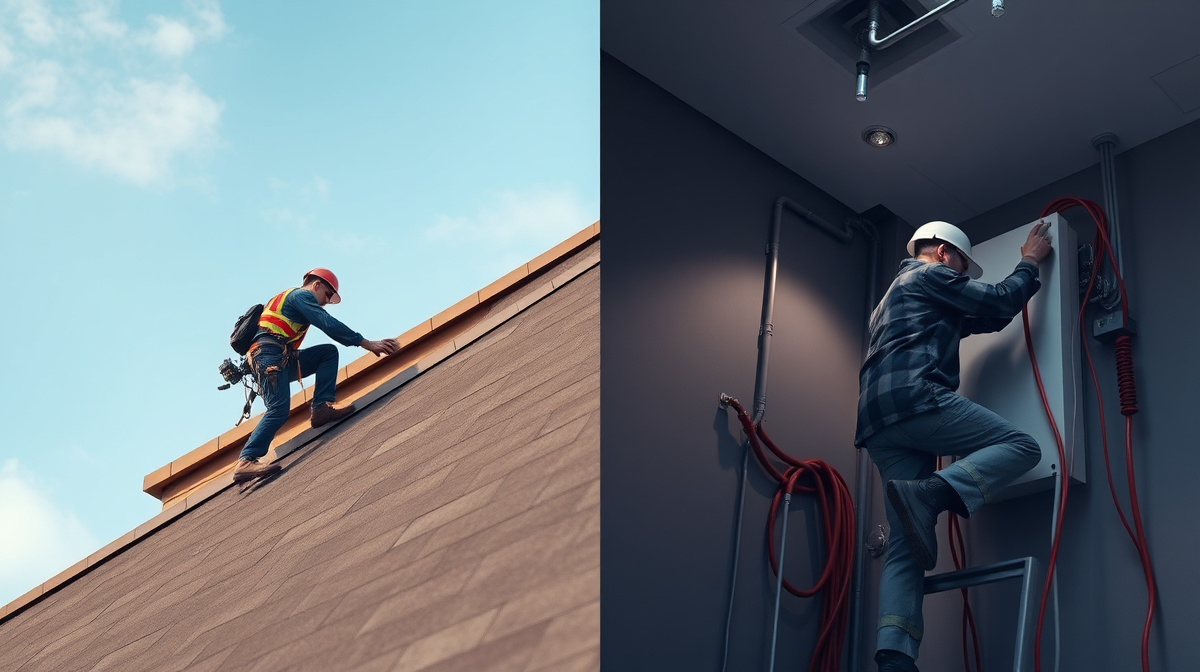
Every contractor asking “why does my insurance cost so much more than the guy down the street doing a different trade” is really asking about class codes, whether they know that term or not. Workers’ compensation is priced per $100 of payroll, and the rate applied to that payroll is set by a classification code — a standardized category, maintained by NCCI (the National Council on Compensation Insurance) or a state-specific rating bureau, that groups workers by the kind of injury risk their job actually carries. Roofers get one code. Electricians get another. The codes exist because a payroll dollar earned nailing shingles forty feet up doesn’t carry the same injury risk as a payroll dollar earned running conduit in a panel room, and the rating system is built to reflect that difference rather than pretend it away.
This is the piece that gets lost when contractors compare notes across trades: class code differences aren’t a pricing quirk or a carrier being arbitrary. They’re a direct reflection of documented, industry-wide injury frequency and severity data for each classification. Understanding the logic doesn’t make the bill smaller, but it does make it predictable — and it explains why a generic contractor insurance quote that applies one flattened rate logic across every trade gets so many contractors’ costs wrong in both directions.
Roofing vs. electrical: the clearest contrast in construction
Of all the trade-pair comparisons in construction, roofing versus electrical is the one that makes the class-code logic click fastest, because the two risk profiles sit at genuinely different ends of the severity spectrum. Roofing work happens at height, frequently multiple stories up, on surfaces that get slick, steep, or unstable — and a fall from that height is one of the most severe injury categories the classification system tracks. Electrical work carries real, well-documented hazards too: shock, burn, and the ladder-and-attic access that comes with running wire through a house. But in aggregate, across the industry, electrical injuries skew toward a different severity profile than a multi-story fall.
That difference shows up in two separate places, not just one. It shows up in the workers’ comp class code itself — roofing is rated among the highest tiers in all of construction, reflecting fall severity, while electrical is typically rated in a moderate-to-higher tier that’s meaningfully lower than roofing’s. And it shows up again in the general liability market: roofing GL is frequently hard to place with standard carriers at all, pushing much of the trade into specialty and E&S markets, while electrical GL is generally written in the standard market. Two separate underwriting questions, both pointing the same direction.
| Primary risk driver | Roofing: falls from height, often multiple stories, frequently the single most severe injury category in construction. Electrical: shock, burn, and ladder-fall risk — real and serious, but statistically lower in catastrophic-injury frequency than a fall from a roof edge. |
|---|---|
| Workers' comp class code tier | Roofing sits among the highest-rated class codes in construction, reflecting fall severity. Electrical is typically rated meaningfully lower — a moderate-to-higher tier that accounts for shock and ladder risk without the same catastrophic-injury frequency roofing carries. |
| General liability market | Roofing GL is frequently placed in the specialty/E&S market — many standard carriers restrict or decline it outright. Electrical GL is generally placed in the standard market, with professional/E&O layered on for design-build or systems work. |
| Coverage priority | Roofing: workers' comp and GL market access dominate the conversation, with umbrella often treated as a practical necessity given claim severity. Electrical: completed-operations wording and, increasingly, E&O for design-build or low-voltage/systems work. |
General, directional patterns reflecting well-documented industry classification trends — not this agency's filed rates. Actual class codes, rates, and market access vary by state, carrier, and experience mod.
None of this means electrical work is risk-free or cheap to insure — it means the rating system is doing exactly what it’s supposed to do: pricing two genuinely different exposure profiles differently instead of averaging them into one number that fits neither trade well. For a deeper look at how each of these profiles plays out in practice, see the full roofing contractor insurance and electrician insurance breakdowns.
The same logic, extended: excavation vs. a GC’s own payroll
The roofing/electrical contrast is the cleanest example, but the same fall-severity-vs- shock-risk logic — really, the broader principle that class code follows documented injury pattern, not job title — shows up across other trade pairs too. Excavation work carries one of the highest class-code ratings in construction for a different reason than roofing: trenching cave-ins are a specifically OSHA-regulated hazard, heavy equipment operation carries severe injury potential, and underground utility strikes can turn into catastrophic third-party damage claims. A general contractor’s own direct employees, by contrast, are frequently office staff and superintendents coordinating subcontracted trades rather than performing hands-on excavation work themselves — and that payroll is typically rated in a much lower class-code tier.
This is exactly where a class-code-only view of insurance cost breaks down if you stop there. A GC’s workers’ comp bill may look modest because their own payroll sits in a lower-risk classification — but their real cost driver is somewhere else entirely: GL limits, umbrella coverage, and contractual/vicarious liability, since courts and contracts routinely hold a GC responsible for the overall jobsite even when every hour of hands-on work was performed by a sub. Class code explains the workers’ comp line. It doesn’t explain the whole insurance program.
| Primary risk driver | Excavation: trenching cave-ins (a specifically OSHA-regulated hazard), underground utility strikes, and heavy-equipment operator injury. A GC's own direct payroll: mostly supervisory and coordination work — site visits, scheduling, safety oversight — not hands-on trade labor. |
|---|---|
| Workers' comp class code tier | Excavation carries a high class-code rating reflecting heavy-equipment and trenching risk. A GC's own W-2 staff, when they're primarily office and superintendent roles rather than subbed trade labor, are typically rated in a much lower tier — the GC's real cost driver shows up elsewhere. |
| Where the real cost sits | For excavation, it's mostly workers' comp and confirming GL includes explicit XCU (explosion, collapse, underground) coverage. For a GC, it's less about payroll class code and more about GL limits, umbrella, and contractual/vicarious liability — a GC can be held responsible for a subcontractor's jobsite injury even though that sub's labor never touches the GC's own workers' comp policy. |
Directional patterns only. A GC's exposure and an excavation contractor's exposure are structured differently enough that comparing workers' comp class codes alone misses most of the real cost picture for both.
Plumbing vs. HVAC: a smaller gap, and a reminder that class code isn’t everything
Not every trade-pair contrast is as dramatic as roofing vs. electrical, and plumbing vs. HVAC is a useful example of a narrower gap. Plumbers spend a lot of their working hours in crawlspaces, basements, and confined trenching — awkward-position, back-and-joint-strain risk more than acute, dramatic injury. HVAC contractors add a fall-risk dimension plumbing mostly doesn’t carry — rooftop unit access and attic work — on top of combustion equipment and gas-line exposure. The result is that both trades generally land in a moderate class-code range, with HVAC often rated a step above plumbing rather than dramatically higher.
What this pair illustrates well is that class code is one input, not the whole story. Plumbing’s defining cost driver isn’t its workers’ comp class code at all — it’s completed-operations water damage, the classic claim where a connection fails months after the job and the resulting water or mold damage dwarfs the original invoice. HVAC’s standout exposure is pollution liability tied to refrigerant handling. A contractor comparing insurance cost purely by class code, without accounting for the coverage line that actually drives claims in their trade, is comparing the wrong number.
| Primary risk driver | Plumbing: confined-space and crawlspace work, trenching for sewer/water lines, awkward-position back and joint strain. HVAC: rooftop unit access (a fall-risk dimension plumbing mostly doesn't carry), combustion/gas-line work, and refrigerant handling. |
|---|---|
| Workers' comp class code tier | Both trades generally land in a moderate range, well below roofing or excavation — but HVAC's rooftop and attic access typically nudges it a step above plumbing's mostly ground-level and below-grade work, even though neither carries anything close to roofing's fall-severity profile. |
| The line that isn't about class code at all | Plumbing's real distinguishing cost driver is completed-operations water damage and, for sewer/septic work, pollution liability — not workers' comp. HVAC's distinguishing driver is pollution exposure from refrigerant handling. Both show that class code is only one input, not the whole story. |
General patterns across the trade. Actual class-code assignment and rates depend on state, carrier, and how a given operation's work mix is classified.
What this means for how you shop for coverage
The practical takeaway across all three comparisons is the same: class code is real, it’s documented, and it’s not something an agent can simply negotiate away — but it’s also only one piece of what actually drives a trade’s total insurance program. A quote process that starts and ends with “what’s your revenue and payroll” captures the class-code piece at best, and misses the completed-operations wording, the pollution exposure, the GL market-access problem, or the contractual liability question that’s often the bigger cost driver for that specific trade.
A few things worth checking against your own coverage, regardless of trade:
- ✓Confirm the class code(s) on your workers' comp policy actually match the work your crew performs — misclassified payroll is a common, fixable source of overpaying.
- ✓Don't judge total insurance cost by workers' comp alone — GL market access, completed-operations wording, and pollution exposure often matter more for your specific trade.
- ✓If your crew does more than one type of work (e.g., an electrician doing some design-build systems work), ask whether that work should carry its own classification or coverage line.
- ✓Compare your coverage combination to what's typical for your trade specifically, not to a generic contractor bundle averaged across every trade on the jobsite.
None of the comparisons above are meant to stand in for your actual filed rate — class codes, experience modifiers, and premiums vary by state, carrier, and claims history, and the only way to know your real number is to get a quote built around your specific trade and operation. That’s the whole premise of pricing insurance by trade classification instead of by a flattened generic contractor label.